 30 Mar 2026
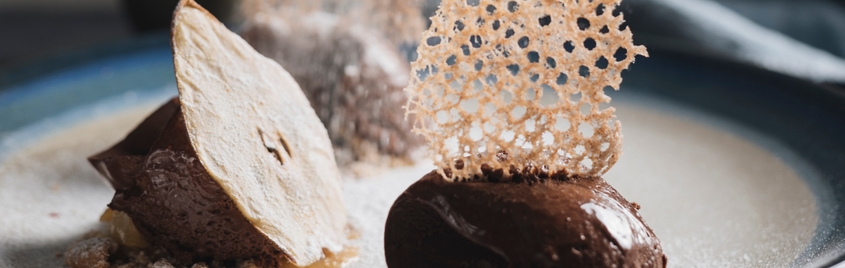
In today’s luxury hospitality landscape, desserts are expected to do more than satisfy a sweet craving — they must create a visual moment. A plated entremet in a five-star hotel or a signature pastry in a boutique patisserie is judged first by its structure, symmetry, colour harmony, and refinement. Taste follows.
This shift has fundamentally changed professional pastry education. Modern bakery and confectionery courses no longer focus only on technique; they train students to design.
At the International Institute of Culinary Arts (IICA), visual aesthetics are not treated as decoration — they are treated as a core competency.
Why Visual Aesthetics Matter in Modern Patisserie
Professional pastry chefs must understand that presentation influences perception. A well-designed dessert communicates:
- Precision and professionalism
- Brand identity and creativity
- Texture contrast and balance
- Portion control and refinement
- Commercial value
In luxury environments, a dessert must look consistent across every plate. Clean edges, smooth glazing, sharp layering, and intentional plating separate trained professionals from hobby bakers.
This is why structured certified baking courses now incorporate design thinking into daily practical sessions.
Beyond Decoration: Designing with Intent
Visual aesthetics in pastry education involve more than placing garnishes. Students must learn to think critically about:
- Proportion and height
- Colour contrast and harmony
- Negative space on the plate
- Texture mapping (crunch, smooth, airy, glossy)
- Structural integrity
In a diploma in bakery and confectionery, desserts are analysed as compositions. Students are encouraged to sketch concepts, experiment with plating geometry, and refine finishes until they achieve balance and clarity.
Integrating Design into Technical Mastery
Modern pastry chefs must combine artistry with accuracy. For example:
- A mirror glaze must not only shine but flow evenly.
- A laminated pastry must display defined layers.
- A plated dessert must maintain structure from pass to table.
Design is supported by science — correct ratios, controlled temperatures, and precision timing. This integration of mathematics and aesthetics defines professional patisserie training.
IICA’s Baking Courses: Where Technique Meets Design
1. Diploma in Bakery & Patisserie
Duration: 6 Months
Accreditation: Upon successful completion, students receive a Level 2 Diploma in Bakery & Patisserie from City & Guilds, UK
The Diploma in Bakery & Patisserie is one of IICA’s flagship Certified Baking Courses, structured to build strong technical foundations while nurturing artistic precision.
What the Program Covers:
- Artisan breads and fermentation science
- Laminated doughs and viennoiserie
- Classical and contemporary desserts
- Chocolate and sugar work
- Plated dessert presentation and finishing
Over six months of intensive practical training, students learn to analyse structure, flavour balance, and visual harmony. The City & Guilds accreditation adds global credibility, enabling graduates to pursue international career opportunities.
More importantly, the program integrates design thinking into everyday assignments. Students are encouraged to experiment, refine, and reinterpret — moving beyond rigid recipe repetition toward conceptual creativity.
2. Pastry & Hospitality Management Program
Duration: 9 Months Training + 3 Months Internship
Accreditation:
Level 5 Diploma in Hospitality Management from BSI Learning, Australia
Level 3 Diploma from City & Guilds, UK
This advanced program awards a Diploma in Bakery and Confectionery while combining pastry expertise with hospitality management insight.
Key Focus Areas:
- Advanced confectionery and chocolate craftsmanship
- Fine patisserie and dessert architecture
- Bakery production systems
- Menu design and service strategy
- Hospitality operations and business fundamentals
The additional internship provides real-world industry immersion, reinforcing technical training with operational exposure.
Through structured design thinking modules, students conceptualise full dessert menus, explore brand aesthetics, and align product development with market positioning — preparing them not only for kitchen roles but also for leadership and entrepreneurial ventures.
The IICA Advantage in Visual Training
As a reputed Culinary School in Delhi, IICA ensures students develop:
- Plating geometry and composition awareness
- Precision in glazing and finishing
- Texture contrast and colour balance skills
- Product styling for retail and luxury display
- Industry-ready consistency
Under the leadership vision of Virender S. Datta, IICA continues to elevate hospitality education standards in India, aligning curriculum with international benchmarks while fostering creative independence.
Where Creativity Meets Professional Excellence
Modern pastry demands far more than flavour precision — it requires vision, structural understanding, and refined aesthetic discipline. Today’s professional chefs must design desserts that perform beautifully on the plate, align with brand standards, and maintain technical consistency in fast-paced hospitality environments.
At the International Institute of Culinary Arts (IICA), this philosophy is deeply embedded into every stage of training. Through its bakery certificate course, industry-recognised certified baking courses, and the comprehensive diploma in bakery and confectionery, IICA equips students with both creative insight and professional discipline. As a leading culinary school in Delhi, the institute blends global accreditations, hands-on practical exposure, and design-focused pedagogy to prepare graduates for luxury hotels, artisan bakeries, cruise lines, and entrepreneurial ventures.
For students seriously exploring courses to become a chef in India, choosing IICA means investing in an education that balances science, creativity, and international standards.
Take the next step toward a future shaped by innovation and excellence — enrol in IICA’s Bakery and Confectionery Courses and start building a career where your passion meets professional precision.
FAQs
1. Why are visual aesthetics important in professional pastry education?
Visual aesthetics are essential because modern pastry is judged not only by taste but also by presentation and design. In structured Certified Baking Courses and Bakery and Confectionery Courses, students learn plating techniques, composition balance, and finishing precision to meet global hospitality standards.
2. Is pastry & hospitality management program suitable for students exploring Courses to Become A Chef in India?
Yes. Enrolling in a specialised pastry & hospitality management program at a reputed Culinary School in Delhi provides focused training in baking science, pastry design, and hospitality operations. These programs are excellent pathways for students looking for serious Courses to Become A Chef in India and build careers in luxury hotels, bakeries, and global culinary brands.